SOFTWARE
| Home
Software |
Software is
the key to operating modern thermal imaging equipment. It should be
flexible, powerful, and easy to use. Some basic feature requirements are
illustrated below.
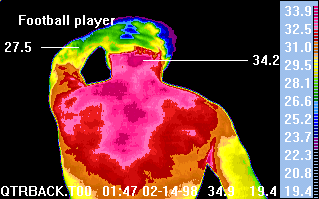
An unlimited selection of
pallette combinations should be available to the user and easily accessible
for use with any individually stored image. This provides a variety of
ways to look at the same image. The user should be able to create their
own customized pallettes. Through the different color combinations, pattern
formations can be highlighted or distinguished, and can provide significant
information that might be overlooked.
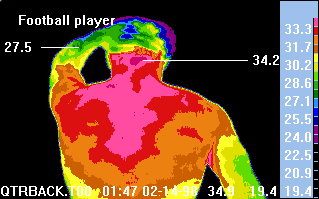
It should be possible to designate a relative temperature reference point at any location on the image with some sort of marker. Text information should also be an option to include on the image.
Any number of colors from 4-256 should be easily applied to the image using a simple sliding scale. In comparison with the image above, the same image is viewed below with less colors. Broad areas are defined, but more discreet thermal zones of interest are not depicted. Therefore, for interpretation, it is important to have flexibility with the number of colors on the scale.
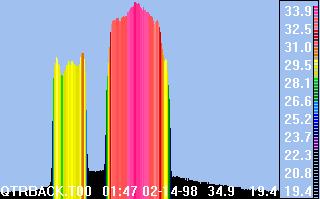
Basic image information should include the stored file name, date of the image, and thermal range captured for the image. Graphing capabilities should be a standard part of the software to permit both line graph and bar graph plotting at any vertical or horizontal location on the image. The graph below is plotted at a specific x/y coordinate on the image (at the point designated as 34.2 in the images above).
Thermal imaging software should ideally control the functions of the infrared camera, display of the image, and storage of the data. The resultant image file should be compatible with current PC standards to facilitate rapid transfer across the internet. Modern thermal imaging cameras should be suitable for remote control over the internet to permit an individual in one city to operate a camera in another city. |